Maintenance, Reliability & Warrantys
Jan 18, 2026
Solar PV vs Solar Thermal vs Heat Pumps for Water Heating: Which Is Best in 2026?

Dr. Sean Moolman
Co-founder & COO
South Africans have been hit hard by electricity price increases since shortages and load shedding started in 2008. Electricity prices rose more than 600% in real terms over this period — six times faster than inflation (see our blog article on this topic).
This sharp rise in electricity costs, combined with growing concern about the health and environmental impact of South Africa's coal-fired power, has driven the search for ways to reduce dependence on the grid.
Water heating is the single biggest energy consumer in South African households, accounting for 40% of total household energy use (ref). That makes it an obvious target for cutting your electricity bill.
South Africa's National Building Regulations also set minimum energy efficiency standards through Regulation XA, requiring all new residential properties to derive at least 50% of annual water heating from a source other than grid electricity.
Your water heating options
There are several ways to heat water, including:
Solar PV (photovoltaic)
Solar thermal (also called 'solar geysers')
Heat pumps
Natural gas or LPG
Biomass
PVT (PV thermal — a combination of solar PV and solar thermal)
With so many options, the inevitable question is: which is best?
Like most things, the answer depends on your priorities and circumstances. Location and climate, household size, budget, electricity supply reliability, and environmental considerations all affect which water heating option suits you best.
But some options have clear advantages over others. Let's start with cost.
Lifetime cost matters
When considering the cost of any system, look at total lifetime cost. This includes upfront system and installation costs (capital cost), plus ongoing costs like electricity or fuel, maintenance, and repairs. System lifetime also matters.
There's a methodology that accounts for all these factors called Levelized Cost of Energy (LCOE). It calculates the total cost per unit of energy (a kWh or 'kilowatt-hour') for different energy options.
The graph below shows the overall cost or LCOE for several water heating options in South Africa as of 2026
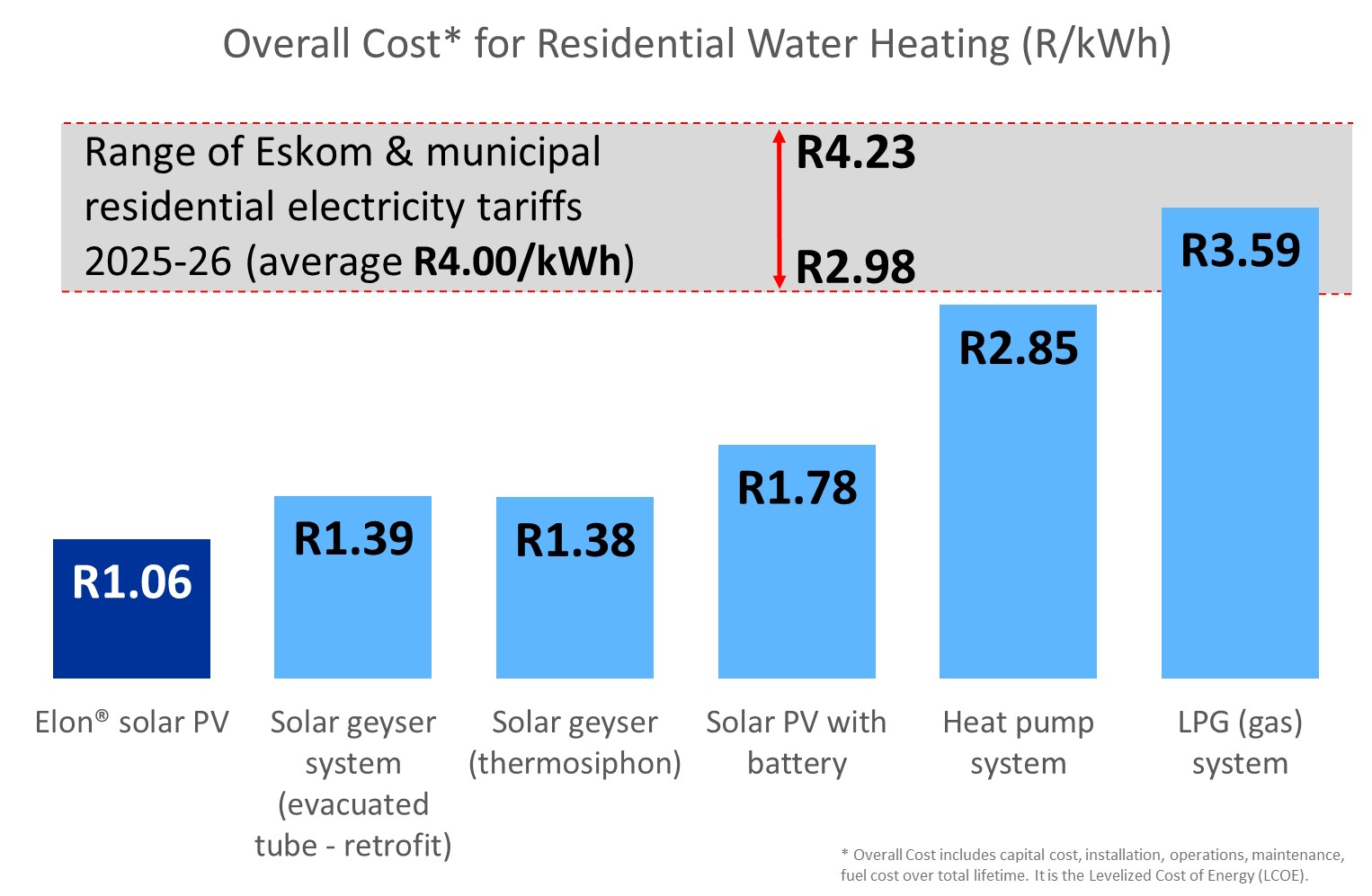
Solar PV and solar thermal are by far the lowest-cost options for heating water. The most expensive? Electricity from Eskom or your municipality.
Heat pumps require maintenance and have ongoing electricity costs, while gas is expensive and fluctuates with oil prices.
Comparing the top three alternatives
Of course, cost isn't everything. The table below compares key factors for the three most common alternative water heating options: solar PV, solar thermal, and heat pumps.
Factor | Solar PV | Solar Thermal | Heat Pumps |
|---|---|---|---|
Additional plumbing required? | No | Yes | Yes |
Retrofit to standard electric geysers? | Yes | Some designs can be retrofitted | Requires modifications |
Noise? | No noise | Some noise (pumped systems) | Yes |
Works during power failures? | Yes | Yes for some (thermosiphon & pumped with solar PV) | No |
Frost issues? | No | Yes (requires more expensive indirect system) | Reduced performance |
Winter performance | Good | Not as good | Not as good |
Overheating & water wastage? | No | Yes (stresses system & wastes water) | No |
Aesthetics | Good | Not good for thermosiphon & requires stronger roof | Good (if hidden) |
Maintenance required? | No | Yes – every few years | Yes - annual |
Price | Comparable or less expensive than pumped solar thermal. Less expensive than heat pumps | Thermosiphon solar thermal systems are cheapest | Most expensive |
Lifetime | 30+ years | 10 – 15 years | 10 - 15 years |
Roof space required | 2 – 3 x more than solar thermal | 2 – 4 m² | None, but requires space for system |
Lifetime cost of energy | Best | Good | Worst |
Section 12B tax benefit for ‘build to rent’ property developers? | Yes | No | No |
The verdict
Based on cost and the factors above, solar PV and solar thermal are clearly preferable to heat pumps. (Heat pumps may be the only practical option in some situations — for example, multi-storey buildings with insufficient roof space for solar PV, though carports or ground-mounted solar PV can help solve this.)
If upfront cost is your main concern, thermosiphon systems (with the tank on the roof) are the lowest initial cost option. But when you factor in system lifetime and maintenance costs, solar PV is the most cost-effective over time.
Considering winter performance, noise, power failure resilience, maintenance requirements, overheating, and water wastage, solar PV has the edge over solar thermal.
Whichever option you choose, it's never made more financial and environmental sense to switch to alternative water heating.
Dr. Sean Moolman
Co-founder & COO